Thursday, May 21, 2015

Marketing in the Real World

Using traditional methods in a social media age


Cover of Start a Revolution
Libraries are often willing to pay upwards of 95% of their annual budgets for staffing and materials, while allocating no funds for marketing. A library with a $4 million budget shouldn’t allocate only $5,000 to making patrons aware of all the events and services that the $4 million provides. Some of that money should be shifted to help the community become more aware of the library’s value.
Social media is a cost-effective marketing tool, but libraries should still market in traditional media. Social media is not intended to replace real-world marketing altogether.

An overarching theme

One key to successful marketing is to make your promotional materials memorable so they don’t get lost in the clutter that inundates people daily. Libraries can accomplish this without having to come up with completely original material.
At Craighead County Jonesboro (Ark.) Public Library (CCJPL), we select an annual overarching theme for all the marketing we’ll do in a given year.
E­xamples include:
  • typography, in which the words are also the art
  • vintage, reminiscent of 1950s and 1960s artwork
  • retro, reflective of advertising styles from the 1970s, 1980s, or 1990s
  • street art, which is quite powerful in catching people’s attention
  • internet memes, which are popular ideas, images, or trends that circulate on the internet and become pop cultural phenomena
Our 2012 marketing campaign took advantage of the popularity of internet cards—simple compositions with sketches accompanied by brief, usually humorous, text. Part of e-cards’ effectiveness in print is achieved from people’s expectation of seeing them only in a digital format. e-cards capture an audience’s attention when viewed outside their expected medium.
Capturing an audience’s attention is one of the biggest challenges in a world where people are constantly bombarded with advertising and information. Selecting an overarching theme every year has two advantages over developing unique marketing material to promote a service or event each time.
It simplifies the process of marketing individual events or services by providing a predetermined conceptual foundation from which to work. For example, when we promoted our concert series in 2012, we knew at the outset that our posters should look like e-cards in order to adhere to the year’s theme. This allowed us to focus on what artwork and phrases would best promote the concerts.
An overarching theme benefits the library by keeping the message consistent and recognizable throughout the year.
The theme builds branding. As you produce more thematic materials, your audience is more likely to pay attention because they liked what you did before.
Changing the theme annually is probably useful. Things don’t necessarily retain their popularity long term, and we don’t want new content to become dated. It also allows the library to come up with new and creative ways to increase community awareness while appearing fresh and innovative.

Billboards


Many libraries consider billboards to be too expensive to use as a marketing tool. However, they can be cost-
effective given the level of exposure they provide. Traffic volume and location determine the cost of leasing billboards. Price also fluctuates with the market. Vendors are likely to negotiate price if they have a number of billboards not currently in use, because a billboard with advertising on it at any price is preferable to a blank one. It’s worth finding out what billboards are available in your community and asking what kinds of deals can be negotiated.

The contrarian argument against billboards is that the same people will see it every day. This is actually a good thing. A billboard is a yearlong reinforcement to people that they should visit the library. Compared with the cost of direct mailing at about 30 cents per address, billboards might be considered an excellent marketing investment. The level of exposure is worth it, whether a library can buy one billboard or a dozen.
Because of the cost of each billboard, don’t promote specific library events or services. Instead, try to instill curiosity and sell the library as a place to check out. Regardless of a library’s overarching theme, it’s important to ensure the billboards look nothing like the others along the roadside. Simple text and images, a design that maximizes minimalism, tend to cut through the clutter and have a greater emotional impact.

Posters

Library posters are common. Many libraries buy preprinted posters from vendors. These posters look nice inside the library, but they do little to brand or market a specific library and their reach extends only to regular patrons.
For successful community marketing, posters should be distributed outside the library and be just as engaging as billboards. The library should have a strategy for getting posters into the community and in front of potential patrons. A number of businesses and organizations in every community will welcome posters in their windows. An eye-catching poster placed in the window of a popular restaurant has the potential to reach thousands of people a week.
Even if some people aren’t interested in a particular event, a poster that catches their eye is still a great promotion. It’s branding that keeps the library in the front of people’s minds.

Postcards

Postcards are simply miniature posters. One of the advantages of printing and distributing them is they can have the creative work on the front and the event information on the back. This allows for the artwork and marketing to be showcased while still delivering all of the pertinent facts.
As with other marketing materials, appealing artwork and a good tagline will motivate people to read the card and remember what the library is promoting. Like posters hung in store windows, thorough postcard distribution outside the library is sure to increase program attendance and bring new patrons to the library.
Postcards should be placed at every customer service point in the library and given to every patron at checkout. Staffers need to be aware of what event is currently being promoted and actively engage patrons about attending, using the postcard as a take-home reminder.
I’ve been questioned about sending postcards via direct mail. I disagree with this approach. First, it’s relatively costly to do direct mailings to a significant number of people. Second, bulk mailings might get mixed in with junk mail and could to be tossed into the trash with it as well.

Bookmarks

Bookmarks are the oldest and most common promotional items given to patrons.
At CCJPL, we design our bookmarks to reflect the year’s overarching theme. We don’t necessarily use bookmarks to promote specific events but rather the library as a whole, with general library information on the back, such as the address, phone number, hours of operation, website, and Facebook page. The goal is to provide information that will expose patrons to the wide range of offerings the library provides. The bookmark serves as a handy reminder to patrons that we’re a lot more than just the book they’re currently reading.
Custom bookmarks may be more expensive than bulk-ordered, unbranded bookmarks, but the opportunity to provide information specific to your library outweighs any cost difference between the two.

Yard signs

Yard signs are effective for broad promotion and can generate a lot of talk around town. They should be viewed as mini-billboards, adhering to the concept of promoting the library in a general way, rather than promoting specific services or events. They are a relatively expensive marketing tool on a per-item basis, so distribution should be handled carefully to avoid waste.
CCJPL’s first experience with yard signs came during the 2012 presidential election. Seeing all of the candidate yard signs cluttering the corners of busy intersections, I decided it would be funny to come up with a library sign with a catchy phrase to place among them. In a guerrilla marketing-like move, we had signs printed with the phrase, “Public Library: We don’t need to run for office,” and placed them among the political signs. Our signs were a huge hit, and a number of patrons wanted them for their yards.

Measuring results

Most of these traditional media aren’t new to libraries. We’ve been using them for years. In many ways, these strategies and techniques aren’t so much revolutionary as they are evolutionary. However, an evolution in practices can lead to a revolution in results.
CCJPL hosts four concerts every summer. We’ve always promoted them through traditional means but without much strategy.
In 2011, we averaged 300 attendees per concert. In 2012, we created posters to promote the events. Our average that year was 300 attendees. In 2013, we again hung posters around town, but we also distributed more than a thousand postcards, posted about the concerts on Facebook, and made sure to mention the events on radio and TV multiple times in advance. Our average attendance per concert that year was just over 500. That’s a 67% increase. The only difference was our approach to increasing community awareness. We created engaging marketing material that presented the concerts as something people wouldn’t want to miss.
These sorts of results are attainable by any library willing to reach out in an effective way. It isn’t as much about doing something radically different. It’s about being better at doing the things we’re already doing. The goal is to keep the community continuously aware of the library and do so in a way that will entice them to engage, attend, and participate.

Tuesday, May 05, 2015

The Future, Today

Award-winning designers discuss the library of the future


The library is in a constant state of evolution, not only in what it offers to patrons but also in its physical presence. Eight winners of the 2014 International Interior Design Association/American Library Association Interior Design Award, which honors excellence in library interior design, spoke with American Libraries about the future of library design and how their award-winning work reflects that vision.

Ruth Baleiko, the Miller Hull Partnership

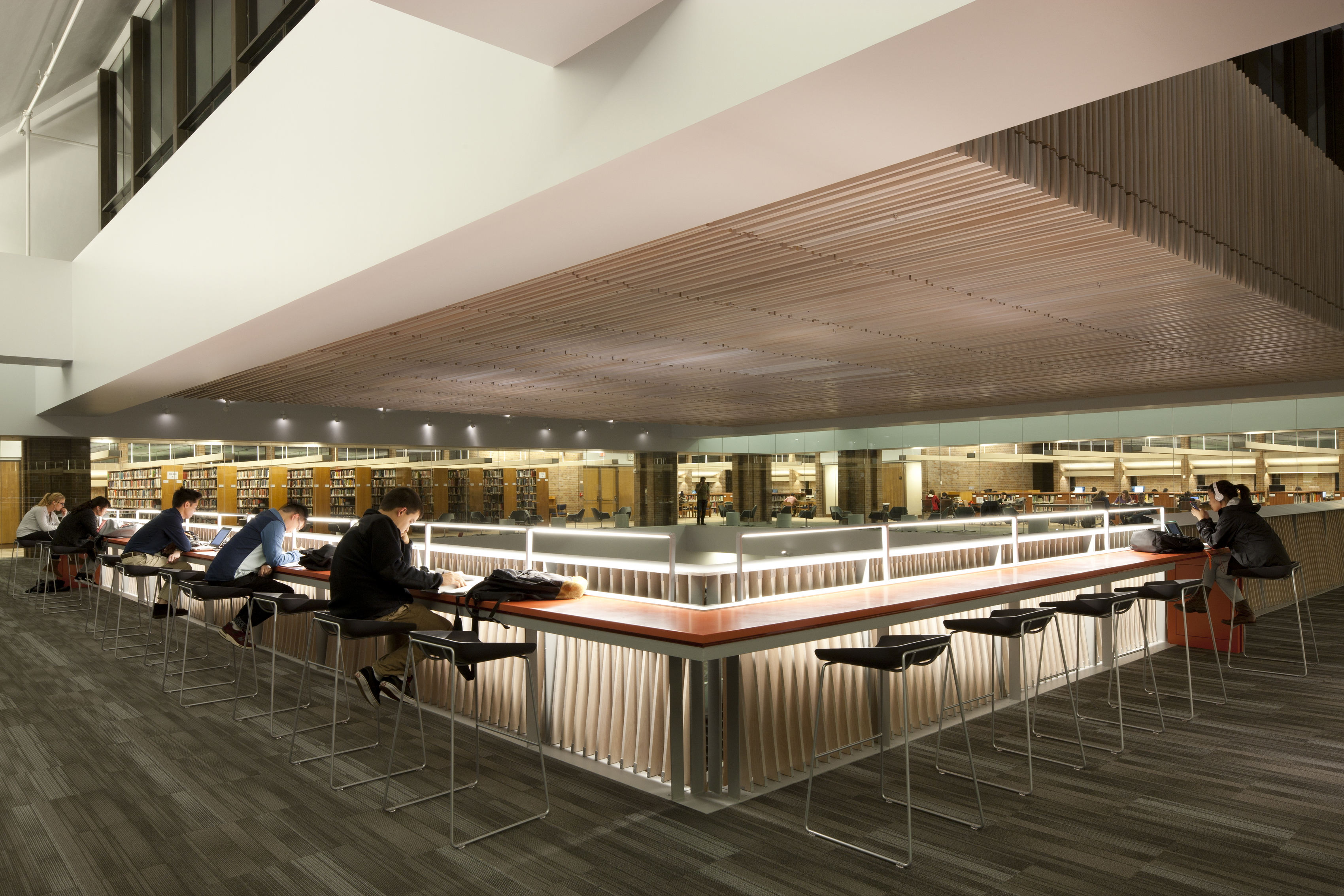
 Odegaard Undergraduate Library at the University of Washington in Seattle
The Odegaard Undergraduate Library at the University of Washington in Seattle. Photo: Lara Swimmer
Odegaard Undergraduate Library, University of Washington, Seattle
“Digital downloads, ebooks, personal content, and live programming compete for space with books, periodicals, microfilm, audio, and video in today’s libraries. The library of the future will be shaped in ways that support and en­hance navigation and exchange of these new forms of information. As more and more demands are made on people’s time, library services must be delivered in ways that are digitally based or conveniently located in public places for people on the go.
“Odegaard reflects the 21st-century evolution of the undergraduate library as seen by the University of Wash­ington. They envisioned it as ‘the students’ office on campus,’ which can provide anything necessary for them to complete their work. This concept suggests a stronger relationship between student learning outcomes and the library. Our team seized this and worked with the univer­sity to identify a series of behaviors or learning experi­ences that global citizens should have as part of their university education. This list acted as the driver for design interventions within the building: All the elements we added were directly related to accomplishing and express­ing those learning outcomes. Use of color, graphics, and wood scrims helped define each of these elements and tie together the entire space.”

Lenda Sturdivant, Dewberry

 Midland (Tex.) Centennial Library
Midland (Tex.) Centennial Library. Photo: Maxwell Filmworks
Midland (Tex.) Centennial Library,Schaumburg Township (Ill.) Main Library Teen Center
“Libraries of the past were very heavy in shelving and housing of materials, whereas modern libraries have made a drastic shift to being almost collection-free. The thought [behind this is] that open space allows users to access more technology, and books could be retrieved from off­site storage locations. I think libraries of the future see the need for both. Collections are being carefully consid­ered so as not to occupy too much square footage. This leaves plenty of open room for tech and social spaces, making libraries a community center for multiple activi­ties. This is the case with both the Midland Centennial (Tex.) Library and Schaumburg Township (Ill.) Main Library. Midland houses a large genealogy department, as well as multiple banks of public computers, and a media room for recording audio and video. The Schaumburg Teen Center follows suit with green-screen motion picture recording capabilities and audio and video record­ing facilities.
Lyn Rice, Rice+Lipka Architects
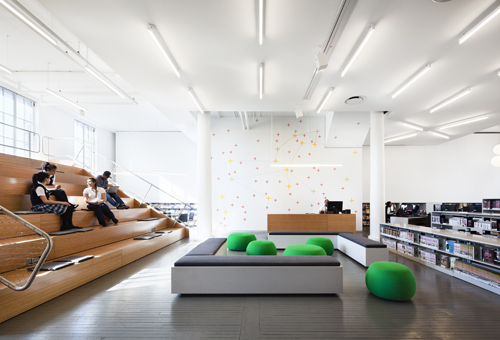
New York Public Library Hamilton Grange Teen Center. Photo: Michael Moran
New York Public Library Hamilton Grange Teen Center
“Libraries are becoming more open and light-filled and, in turn, becoming a less formal place for groups to come together and meet. New York Public Library wanted to build a place where teens can hang out and be themselves with minimal supervision. We created this space by opening the teen center’s floor plan and constructing niches for different types of activity like Guitar Hero and Nintendo Wii. Kids can be loud if they want, but there is also plenty of room for quiet areas. The open floor plan and lowered sightlines allow one adult to oversee the entire area.”
  Libraries are becoming more open and light-filled and, in turn, becoming a less formal place for groups to come together and meet.

Brian Lee, Skidmore, Owings, and Merrill

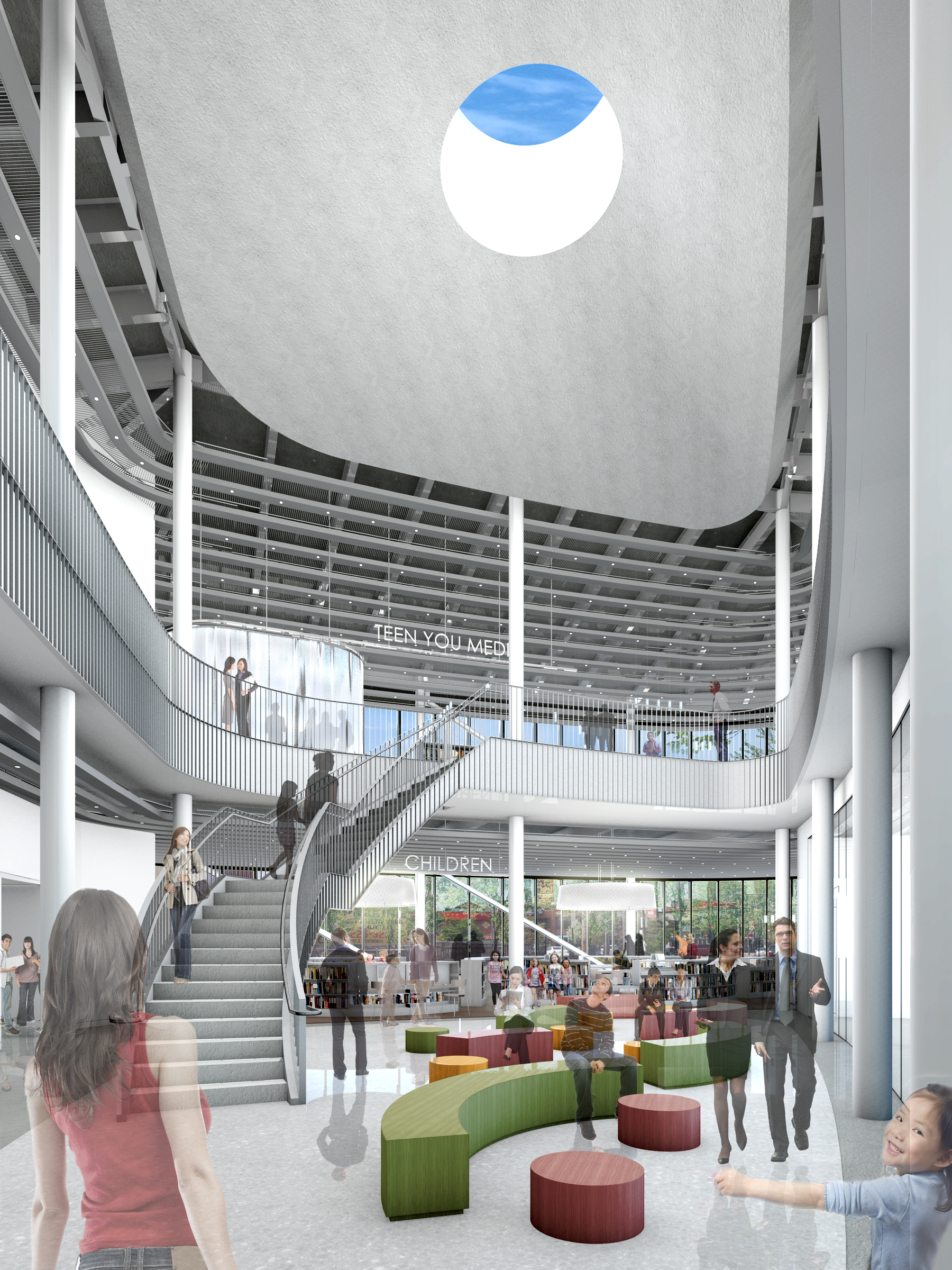
Chinatown Public Library in Chicago
Chinatown Public Library in Chicago. Photo: SOM
Chinatown Public Library, Chicago
“Libraries in the future will continue to change and respond to the ways we seek knowledge. There will be more flex­ible spaces for evolving services and forms of information offering. These spaces, in the end, must be good archi­tecture–human scaled; full of natural light; built with materials that are engaging and durable; and connected to the outdoor context, both through how the building is shaped in relationship to its surroundings, as well as through how it responds to the climate. Library staff in the future will be organized on the floor to be more effec­tive ‘information guides’ to help patrons. Developing a plan and section that allows good sightlines and easy circulation is essential.
“Our design of the Chinatown Public Library incorpo­rates a glass-walled community room that was placed at the ground level to be fully visible to the street and com­munity. It is also adjacent to the library exhibition and central circulation hall. This allows the space to be a flex­ible, multipurpose room at the center of the library. To ensure maximum flexibility, there are very few enclosed spaces—the open plan can accommodate multiple uses and furniture or fixture arrangements over time. Eye-height bookshelves in the adult and teen areas create a sense of openness while still allowing for the creation of informal collaborative areas and intimate reading spots.”

Brad Lukanic, CannonDesign

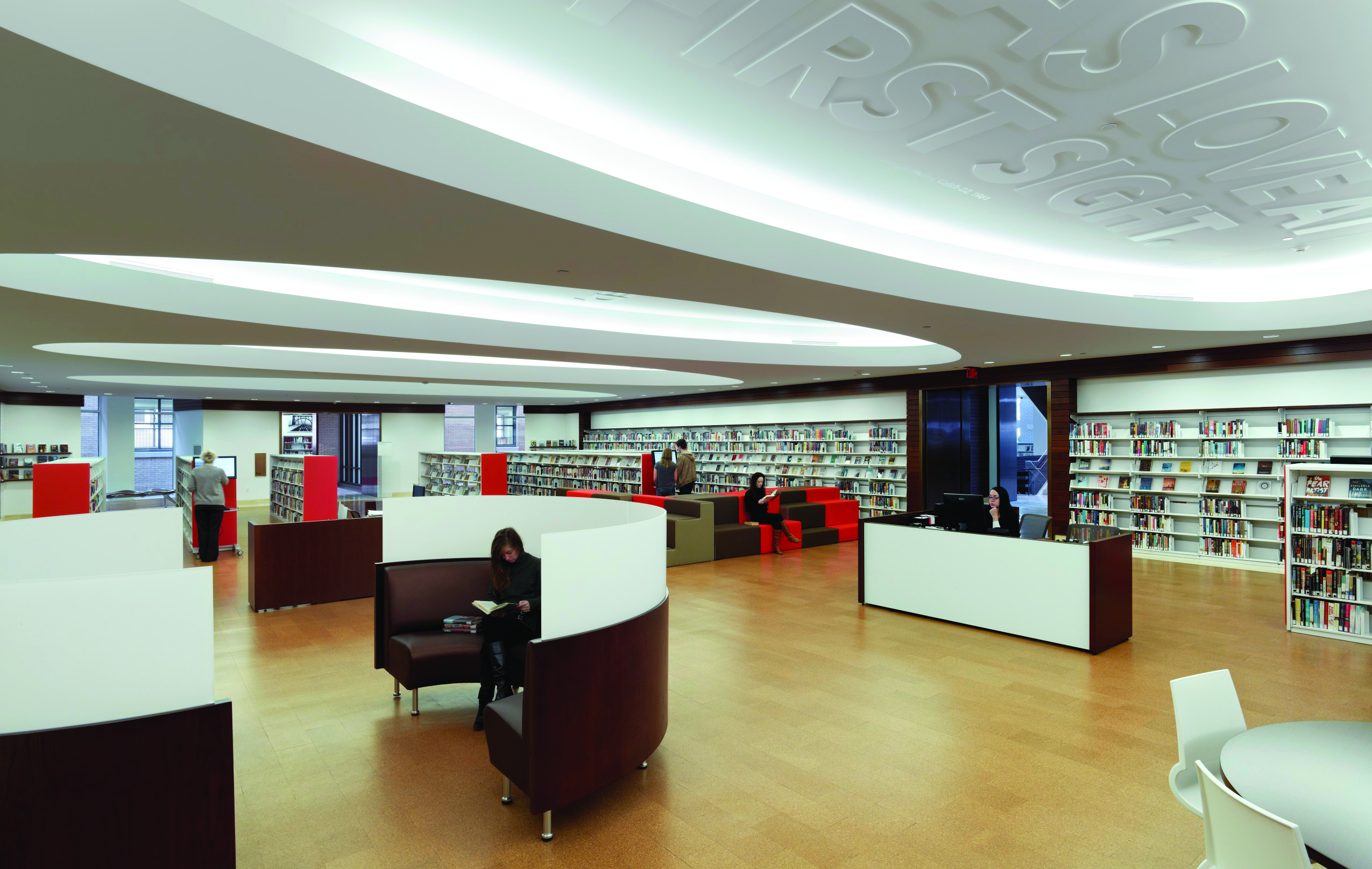
St. Louis Public Library's Central Library. Photo: Timothy Hursley
St. Louis Public Library’s Central Library. Photo: Timothy Hursley
St. Louis Public Library, Central Library
“There are robust changes happening to library spaces, and the renovations of the St. Louis Public Library’s Cen­tral Library reflect that. Built in 1912, the library encap­sulated the grandeur of the age, but it was also about bringing the community together. Much has changed in the more than 100 years since its opening, but the Central Library is still a community gathering space. To preserve that and move forward, we had to rethink what was in­tended in 1912 for today’s patron. This involved removing much of the library’s closed stacks. This massive project created five levels of floors filled with community areas, internet ports, and teen and kids spaces.”
“Libraries are no longer single-purpose repositories of books dedicated to quiet study. They have become dynamic hubs.”

Joel Sanders, Joel Sanders Architect

University of Pennsylvania Education Commons. Photo: Frank Oudeman
University of Pennsylvania Education Commons
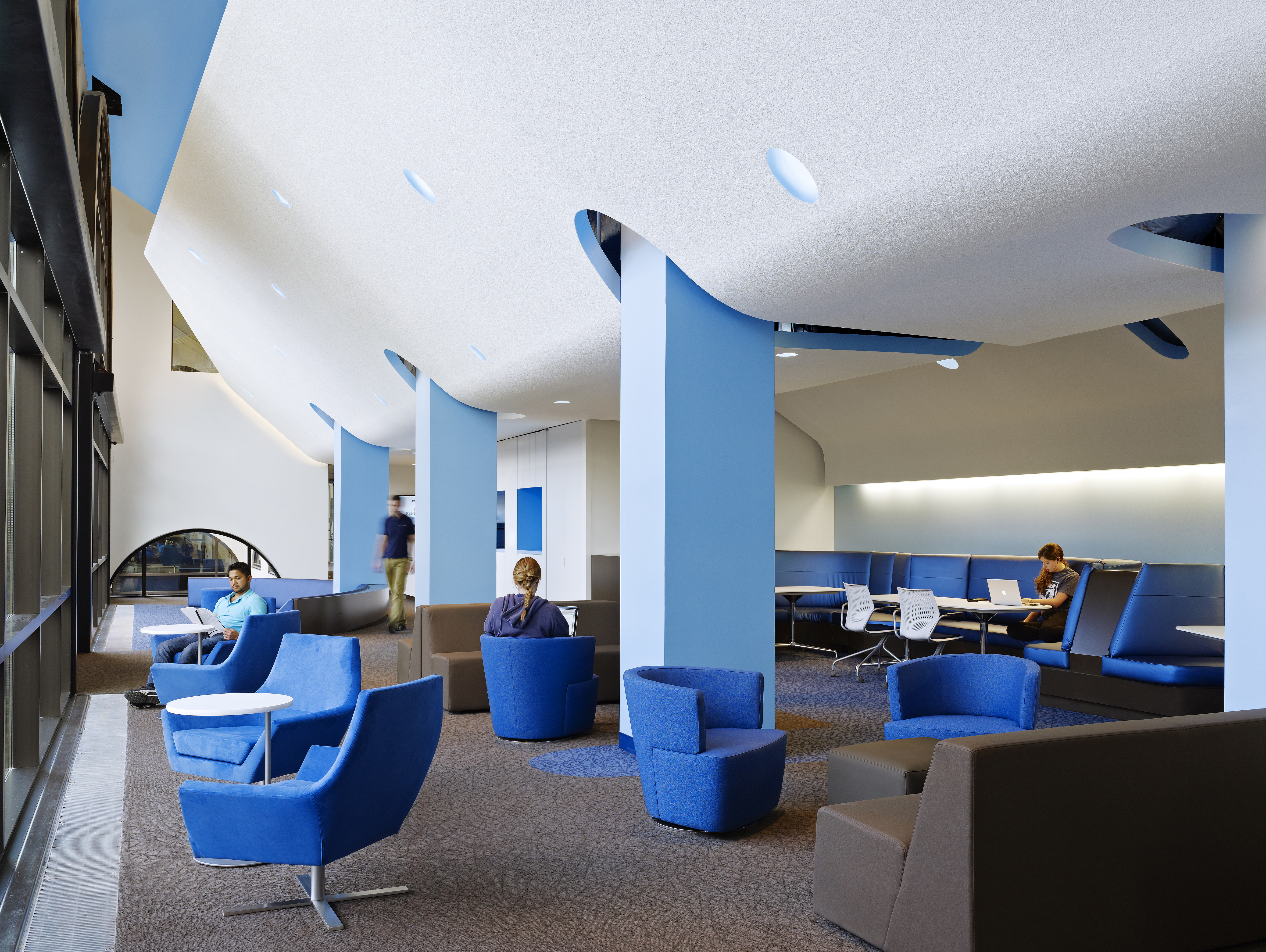
“The transformative impact of digital technologies on 21st-century learning environments is central to my firm’s work. Libraries are no longer single-purpose repositories of books dedicated to quiet study. They have become dy­namic community hubs that function now more than ever as IT centers for students, adults, and underserved com­munities, including seniors and immigrants. Libraries have morphed from formal compartmentalized facilities into casual multipurpose destinations that allow a diverse range of people, alone or in groups, to engage in a variety of media-centric activities, both day and night.
“At the University of Pennsylvania Education Commons, our design treats the library interior as a wired ‘loungescape’ that fosters visual and material continuity between inside and outside. The 300-foot-long library is divided into a series of zones that encourage individual and col­laborative learning. The library is further subdivided into a series of flexible areas with different degrees of acoustic, visual, and spatial enclosure. A suspended acoustical ceil­ing, called ‘The Cloud,’ runs the length of the building and conceals mechanical equipment and is inscribed with backlit apertures that illuminate the space.”

Monday, April 20, 2015

Forecasting the Future of Libraries 2015

Trends in culture, community, and education point to increased potential for expanding the role of libraries of all types


ForecastingFutureOfLibrariesNEW2

I used to think being trendy was a bad thing—a sign of someone who lacks individuality or perhaps is fickle. But in a world of rapid change where people are more and more aware of the latest technology, news, and innovation, being trendy—or at least knowing what’s trendy—is almost essential.
In 2013, the American Library Association (ALA) an­nounced the formation of a Center for the Future of Libraries. The project, initially supported by a grant from the Institute of Museum and Library Services (IMLS), focuses much of its work on identifying emerging trends relevant to the libraries, the librarians, and the communi­ties they serve.
Why trends? Well, as many of us already know, it’s nearly impossible to accurately predict the future. But we can identify trends, and they can be key to understanding what the future might bring. Identifying and organizing trends helps us think about the changes happening in the world and the potential effects they will have on our future. (See Edward Cornish, Futuring: The Exploration of the Future, World Future Society, Bethesda, Md., 2005.) Awareness and understanding of trends can help us actively plan for our own work and for the work with the communities we serve, open new opportunities to innovate and experiment with and within these “currents” shaping society, and better enable us to envision the integral role we can play in the future.
ALA’s center is modeled on the American Alliance of Museums’ (AAM) very successful Center for the Future of Museums (CFM), which promotes social, technological, political, and economic trends to its members and high­lights the many ways that museums are innovating within those trends. CFM and its founding director, Elizabeth Merritt, have used their popular blog (futureofmuseums .blogspot.com), Dispatches from the Future of Museums e-newsletter, and annual TrendsWatch report, to help members and the general public think proactively about what the museum might look like and what they could provide in the next 10, 50, or even 100 years. AAM’s and Merritt’s work continue to inspire and influence the Center for the Future of Libraries, and we benefit from their support and expertise.
Many libraries and librarians have already proven their exceptional ability to spot trends and integrate them into their programs and services. But even the best of us can be overwhelmed by the pace of change, the amount of information, and the multiple sources and sectors from which we piece together our understanding of trends.
This special section focuses on some of the key trends shaping libraries. It pairs with American Libraries’ an­nual coverage of the ALA Emerging Leaders. These librar­ians are, after all, representative of a new wave of library leaders who will help shape our futures—and likely have already contributed to, influenced, or led the trends that we will cover.
The first piece, “Trending Now,” is a quick introduction to the Center for the Future of Libraries’ “trend library.” The trend library is designed to provide the library community with a centralized and regularly updated source for trends—including how they are developing; why they matter for libraries; and links to the reports, articles, and resources that can further explain their significance. As a collection, it will grow to include changes and trends across society, technology, education, the environment, politics, the economy, and demographics.
Makerspaces are playing an increasingly important role in libraries. Four librarians from three library maker­spaces—Tampa–Hillsborough County (Fla.) Public Library System’s The Hive, the Free Library of Philadelphia’s Maker Jawn, and the Innisfil (Ont.) Public Library’s ideaLAB—talk about how maker culture is transforming their libraries and share ideas about this important trend’s direction, in “Making Room for Informal Learning.”
Keeping up to date with changes in education is impor­tant for all of us but especially for those of us working in academic and school libraries. Joan K. Lippincott shares her thoughts in “The Future for Teaching and Learning” on how academic libraries can leverage growing interest in active learning, new media and information formats, and technology-rich collaborative spaces within the higher education environment.
Natalie Greene Taylor, Mega Subramaniam, and Amanda Waugh, all of the University of Maryland’s College of In­formation Studies, look at how school librarians can in­tegrate three trends—the mobility of information, connected learning, and learning in the wild—to keep up with the future of K–12 education in “The School Librar­ian as Learning Alchemist.”
There is news from two library science programs’ ini­tiatives exploring what’s ahead in library education, in “The Future of the MLIS.” This focus on the education of librarians is important for all of us.
For many of us, thinking about the library of the future begins with thinking about the future of the library as space and place. To help illustrate that future, we asked some of the winning architects from International Inte­rior Design Association’s (IIDA) and ALA’s Library Inte­rior Design Awards to talk about current and future trends that influenced their designs, in “The Future, Today.”

Thursday, April 02, 2015

CIIT Lahore library always tried to provide best services to its users. Now, library serial section proudly presents Monthly Bulletin which includes latest library news, Journal Content Services, Newspapers Clippings, Fresh Arrival of Books and many more. You can find all information in one document. Please click the following link to access Monthly Bulletin of CIIT Lahore Library.


See the Following link:

https://www.scribd.com/doc/260669976/COMSATS-Library-Bulletin-February?fb_ref=Default

Wednesday, March 25, 2015

Forecasting the Future of Libraries 2015

Trends in culture, community, and education point to increased potential for expanding the role of libraries of all types


ForecastingFutureOfLibrariesNEW2
I used to think being trendy was a bad thing—a sign of someone who lacks individuality or perhaps is fickle. But in a world of rapid change where people are more and more aware of the latest technology, news, and innovation, being trendy—or at least knowing what’s trendy—is almost essential.

In 2013, the American Library Association (ALA) an­nounced the formation of a Center for the Future of Libraries. The project, initially supported by a grant from the Institute of Museum and Library Services (IMLS), focuses much of its work on identifying emerging trends relevant to the libraries, the librarians, and the communi­ties they serve.
Why trends? Well, as many of us already know, it’s nearly impossible to accurately predict the future. But we can identify trends, and they can be key to understanding what the future might bring. Identifying and organizing trends helps us think about the changes happening in the world and the potential effects they will have on our future. (See Edward Cornish, Futuring: The Exploration of the Future, World Future Society, Bethesda, Md., 2005.) Awareness and understanding of trends can help us actively plan for our own work and for the work with the communities we serve, open new opportunities to innovate and experiment with and within these “currents” shaping society, and better enable us to envision the integral role we can play in the future.
ALA’s center is modeled on the American Alliance of Museums’ (AAM) very successful Center for the Future of Museums (CFM), which promotes social, technological, political, and economic trends to its members and high­lights the many ways that museums are innovating within those trends. CFM and its founding director, Elizabeth Merritt, have used their popular blog (futureofmuseums .blogspot.com), Dispatches from the Future of Museums e-newsletter, and annual TrendsWatch report, to help members and the general public think proactively about what the museum might look like and what they could provide in the next 10, 50, or even 100 years. AAM’s and Merritt’s work continue to inspire and influence the Center for the Future of Libraries, and we benefit from their support and expertise.
Many libraries and librarians have already proven their exceptional ability to spot trends and integrate them into their programs and services. But even the best of us can be overwhelmed by the pace of change, the amount of information, and the multiple sources and sectors from which we piece together our understanding of trends.
This special section focuses on some of the key trends shaping libraries. It pairs with American Libraries’ an­nual coverage of the ALA Emerging Leaders. These librar­ians are, after all, representative of a new wave of library leaders who will help shape our futures—and likely have already contributed to, influenced, or led the trends that we will cover.
The first piece, “Trending Now,” is a quick introduction to the Center for the Future of Libraries’ “trend library.” The trend library is designed to provide the library community with a centralized and regularly updated source for trends—including how they are developing; why they matter for libraries; and links to the reports, articles, and resources that can further explain their significance. As a collection, it will grow to include changes and trends across society, technology, education, the environment, politics, the economy, and demographics.
Makerspaces are playing an increasingly important role in libraries. Four librarians from three library maker­spaces—Tampa–Hillsborough County (Fla.) Public Library System’s The Hive, the Free Library of Philadelphia’s Maker Jawn, and the Innisfil (Ont.) Public Library’s ideaLAB—talk about how maker culture is transforming their libraries and share ideas about this important trend’s direction, in “Making Room for Informal Learning.”
Keeping up to date with changes in education is impor­tant for all of us but especially for those of us working in academic and school libraries. Joan K. Lippincott shares her thoughts in “The Future for Teaching and Learning” on how academic libraries can leverage growing interest in active learning, new media and information formats, and technology-rich collaborative spaces within the higher education environment.
Natalie Greene Taylor, Mega Subramaniam, and Amanda Waugh, all of the University of Maryland’s College of In­formation Studies, look at how school librarians can in­tegrate three trends—the mobility of information, connected learning, and learning in the wild—to keep up with the future of K–12 education in “The School Librar­ian as Learning Alchemist.”
There is news from two library science programs’ ini­tiatives exploring what’s ahead in library education, in “The Future of the MLIS.” This focus on the education of librarians is important for all of us.
For many of us, thinking about the library of the future begins with thinking about the future of the library as space and place. To help illustrate that future, we asked some of the winning architects from International Inte­rior Design Association’s (IIDA) and ALA’s Library Inte­rior Design Awards to talk about current and future trends that influenced their designs, in “The Future, Today.”

Thursday, March 12, 2015


Trending Now

A library of trends that matter to libraries

| February 26, 2015
 
The Center for the Future of Libraries’ trend library ( ala.org/transforminglibraries/future/trends) brings together and organizes information from across industries to pres­ent succinct information on trends, including how they are developing, why they matter for libraries, and links to the resources that can further explain their significance.
We’ve selected five trends from the collection to high­light. Visit the trend library to learn more about each and to see the expanding collection of trend information.

Anonymity

Long a hallmark of internet culture, anonymity is a selling feature for new mobile apps such as Whisper and Secret.
Information shared via anonymous apps includes emo­tional confessions, workplace secrets, personal boasts, and inspirational sentiments. Comments, as most do, range from the positive and affirming to the negative and critical, but many of the platforms actively discourage negativity.
Anonymous content has become popular with users and fodder for news organizations, with several apps develop­ing relationships with news outlets.
Several recent stories have brought to light the limited anonymity these applications actually provide—still track­ing user location and connecting to app store accounts, phone numbers, and password chains—making true ano­nymity a near impossibility.
If anonymity encourages deeper discussion and per­sonal revelation, it may actually help build community. Even if anonymity flourishes, people will still need places to formalize relationships, engage in open dialogue, and seek reputable information—spaces and services that libraries and librarians can provide.

Collective impact

In the face of limited resources and combating social is­sues (hunger, poverty, education), organizations are adopting common agendas to address issues within their communities.
John Kania and Mark Kramer introduced the collective impact model, defining it as “the commitment of a group of important actors from different sectors to a common agenda for solving a specific social prob­lem.” Projects utilizing the model experience large-scale so­cial change, from im­p r o v e d cross-sector coordination as opposed to traditional models that leverage isolated in­tervention by individual organizations.
While crafting enhanced solutions, projects using a collective impact model might also provide better experi­ences for individuals affected by these complex social issues, allowing them to simplify navigation over a coor­dinated network of agencies and programs.
Libraries and librarians might become highly valued and critical partners in collective-impact responses to community issues.
But as funders and governments seek more coordi­nated responses to social issues, libraries and librarians may need to strategically align their services and pri­orities with community-wide responses. Participation in collective-impact projects may require increased time and commitment, developing shared interests and strat­egies, managing across staffs and priorities, persuading stakeholders and boards, evaluating a diverse range of activities, resolving disputes, and sharing successes as well as failures.

Fast casual

Fast casual—a popular and growing concept in restaurants positioned between fast food and casual dining—incor­porates counter service, customized menus, freshly prepared and higher quality foods, and upscale and invit­ing dining spaces.
Even as fast casual restaurants lure diners with more natural, local, and organic menu options, they also inte­grate technology, with customer loyalty apps, online or mobile ordering, and mobile payments. This has helped increase their appeal to millennials who are more influ­enced by digital engagement, convenience, authenticity, and emphasis on quality than traditional advertisement.
In other hospitality sectors, fast casual has advanced the growth of living-room-like flexible spaces (multiple and varied seating arrangements, easy-to-find power outlets) that accommodate social and business needs, cater to upscale tastes, and are tech­nologically savvy.
The growth of fast casual is reflective of the ever-changing consumer values, including desires for more aspirational experiences, active and shared spaces, and upscale and tech­nologically connected fea­tures.

Resilience


Resilience includes preparation for and rapid recovery from physical, social, and economic di­sasters, including natural disasters, terrorist at­tacks, or economic collapse. In the wake of several recent natural disasters, including Hurricane Katrina (2005) and Hurricane Sandy (2012), the discus­sion about community resilience has accelerated. A 2012 report from the National Research Council stated, “De­veloping a culture of resilience would bolster support for preparedness and response and would also enable better anticipation of disasters and their conse­quences, enhancing the ability to recover more quickly and strongly. Resilient com­munities would plan and build in ways that would reduce disaster losses, rather than waiting for a disaster to occur and paying for it afterward.”
The Rockefeller Foundation’s 100 Resilient Cities initiative has worked with cities around the world to develop a road map to resilience, including estab­lishing a chief resilience officer, strategy develop­ment; access to private, pub­lic, and NGO partners that can help develop solutions; and membership in a network of like-minded cities.
As city, state, and federal governments adopt resilience as a strategy, libraries may likewise need to align facilities, services, and programs. Resilience re­quires community involve­ment—encouraging individuals to make preparatory and preventive decisions and providing resources and in­formation prior to, during, and after incidents.

Robots

Robots are moving from industrial and factory settings into everyday work, educational, research, and living spaces. These collaborative robots (or CoBots) will be able to perform repetitive tasks and work alongside humans. 
The declining cost of sensors and computing power that allow robots to react quickly and intelligently will help robots become safer and take on greater roles alongside humans. Robots may increasingly be introduced as couri­ers and messengers that can operate in programmable environments. Navigation and abilities may be improved by the increasing connectivity of devices and things (the internet of things) that will equip objects with computing and radio devices detectable and distinguishable for mo­bile robots.
Several libraries have utilized robots to help with ma­terials’ retrieval and sorting. Still other libraries have seen robots and robotics as a next wave for technology access and training, even lending robots to help users experience what might soon be a regular part of their futures.

Tuesday, February 17, 2015

Through Their Eyes


Usability testing to create better user experiences


Whatever issues I may have had with an unnamed discovery tool as a librarian, I always believed that it was an easier tool for students to use than our OPAC. And then I met Steve (not his real name). Steve is a participant in an ethnographic study two colleagues and I are conducting to better understand the research habits and needs of returning students.
I was observing students conducting research to see how they approached it and what tools they used, but when I saw Steve use that discovery tool, it was difficult to focus on anything else. Seeing that he was so overwhelmed by the number of links and buttons on an item record that he couldn’t even figure out how to get to the full text of the article made me realize how difficult all those options make it for the novice to use.

Librarians’ vantage point

As an expert user, I’d never considered how distracting all those options can be because I knew where to click and could therefore easily ignore the features I didn’t need. Seeing how a novice user navigated the system provided me with an insight I never could have had otherwise. Unless we observe or otherwise assess our users, we can’t truly understand how they navigate our systems.
This is why usability testing is such a valuable tool in our assessment arsenal. While there are many different kinds of usability testing methods, the most common typically involves subjects using a website and verbally sharing their thinking as they go through it. Often, subjects are given specific tasks to complete on the website so test givers can see if the subjects take the expected paths or can complete the task at all.
You don’t need a fancy usability lab or sophisticated technologies to conduct a usability test. All you really need is a computer and the ability to take notes. If you want to record the session, you’ll need a microphone and a free tool like Screencast-O-Matic, CamStudio, or Google Hangouts. If you want to broadcast the session to people in another room, Google Hangouts, join.me, or the free version of WebEx would work well for this purpose.

Small sample, big findings

Unlike a survey, you also don’t need a huge sample to be able to learn from a usability test. Some usability experts recommend using as few as three subjects in your study. For a usability test we’re conducting on a new online instructional tool, we’re using six undergraduate students. As I showed in my example above, even watching one student use our systems can provide some valuable insights.
Usability testing also isn’t just for our online tools; it can easily be applied to look at physical space as well. What do people see first when they enter the library? How easy is it to find the children’s room? Seeing how users experience the library building can help librarians notice issues they would never have otherwise. Often, it’s the little things that create a great experience, and usability testing can help pinpoint those that might get in the way.
When Steve couldn’t find the full text, he gave up looking for it and quickly stopped using the discovery tool entirely. If users are willing to try exploring library resources at all in their research, libraries often have only one chance to make a good impression.
Ensuring that our website and tools are as usable as possible is critical. Usability testing can help us discover the bumps in the road we need to smooth over to provide a positive experience for our users.